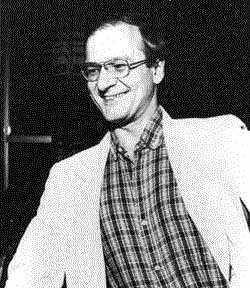
As a composer, I am frequently being asked who are my main influences and who is my contemporary music hero. As for living "classical" composers, I will have to think for a while before answering; however, if the question is revised and includes composers who should have been alive today, then my answer would be simple- Claude Vivier.
Claude Vivier (1948-1983) was a French-Canadian composer whose strange life story could easily become a New-York Times best seller, or a movie by Werner Herzog.
He was an adopted orphan to unknown parents and grew up in Montreal to a poor family. In his teens he was sent to a religious boarding school which was supposed to prepare him for a vocation in priesthood. Much more interested in poetry, guys, and in music, he enrolled at the age of 18 at the local Conservatoire in Montreal, where he studied composition with Gilles Tremblay. He completed his studies in Europe, as many composers did, with Karl-Heinz Stockhausen in Colonge.
However, he didn't reach to his mature distinctive style before he went on a trip to the far east.
This trip, most notably to Bali, has completely changed his conception about life and music.
He became immediately interested in the sounds of the east and in Eastern philosophy, and almost all the works written afterwards reveal that interest- Bouchara, Zipangu, Shiraz, Marco Polo and others.
In 1983, not yet 35, Vivier went to Paris to research the strange death of Tchaikovsky for an opera he wanted to compose. In his last diary entry he wrote that he knows that one day he is going to be stabbed to death. Later that week, he was indeed stabbed to death in a park, by a young Parisian man who was probably his lover, for reasons which remained unknown.
The music of Vivier is enchanting. The listener is easily drawn to the strange long melodies and the scents and spices of this newly undiscovered land of dreams and beauty.
I recommend listening first to his beautiful tone-poem "Lonely Child" (1980), for soprano and orchestra and to Zipangu (1980), for string orchestra. Both are available on a Philips CD, conducted by Reinbert de Leeuw.
Also highly recommended is a 2 DVD set by Opus Arte, entitled "Rêves d'un Marco Polo", which include a documentry on Vivier, and a staged concert performances of his Opera, Kopernikus, and of his most important works- Lonely Child, Prologue pour un Marco Polo, Zipangu and others.
Yet, although he is considered the finest Canadian composer of all times (Ligeti referred to him as the finest French composer of his generation), the music of Claude Vivier is widely unknown and seldomly performed or recorded. While most of his contemporaries in Europe continued their remote mathematical researches in music, and his contemporaries in America became fond of minimalism and of Neo-Romanticism, Claude Vivier found his unique voice, that didn't sound like anything else. He favoured long monophonic melodies/monodies over complex polyphonies, he mastered the essence of spectral music, without becoming too obsessed by it (as Murail and Grisey did)- and along with his studies, he remained almost an innocent child, searching for true beauty.
In an age where true beauty is a foul word and so rare to find (and usually associated with Neo romanticism and fully tonal music), Vivier's music is nothing less than a wonderful, astonishing discovery.

No comments:
Post a Comment