Saturday, 10 January 2009

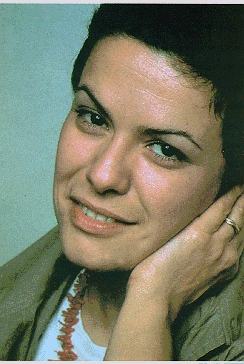
Elis Regina


If I had to choose only one singer- classical, pop or jazz- for a long exile on a desert island, it would inevitably be
Elis Regina. For recreational purposes I wouldn't mind taking also her beautiful daughter with me (Maria Rita, also a famous singer on her own), but I would definitely stick to the music of her mother.

Elis (1945-1982) was born in Porto Alegre, in the south of Brazil. Her career launched already when she was 11, as she won a singing contest on a children radio show.
During the 20 years of her mature life she had released nearly 20 albums, sang and collaborated with the most prominent Brazilian musicians of the time, including Tom Jobim, Milton Nascimento, Chico Buarque, Gilberto Gil and Baden Powell. At the verge of a third marriage and a career change, she suddenly died at the age of 36 from a cocaine overdose.

It is easy to fall in love with her voice, as it is so irresistibly beautiful- You are simply forced to believe every word she says, even if you do not speak one word of Portuguese. When she laugh, you laugh with her, when she cries, you also do. The colors of her voice seem nearly infinitive- she can be bigger than life in songs like "Maria Maria", she can tell a simple story by almost whispering, as in "Ela" and "Pois É", can make you want to dance the samba with her as in "Frevo" and "Roda", and make you cry in tears in "Por toda a minha vida". Her vocal register is equally impressive, as she is as comfortable on high notes as she is in the lowest register (such as in the song "Verao vermelho"). And if you do understand the words, you uncover a completely new layer, as she chooses carefully exactly which words to emphasize in the text, and where to lead the phrase and the dynamics, in an unprecedented sensitivity.
Luckily for us, Elis was fortunate to work with the most gifted arrangers and producers (one of them, the pianist-arranger and producer, César Mariano, became her second husband and father of two of her three children), and the result is usually extremely satisfying.

Nearly all her albums are recommended, especially those from the years 1962-1974. Her most famous collaboration, with the composer Tom Jobim, produced what is regarded the greatest bossa nova album of all times-
"Elis & Tom". This wonderful album includes songs such as "Águas de Março", "Por toda minha vida", "Inutil Paisagem" and more, and is recommended also as an introduction to Brazilian Popular Music (MPB) as a whole.
Unfortunately, we do not have many videos of Elis in performances. However, there is a full length program featuring her called "MPB especial 1973" (which can be watched on YouTube), where she sings some of her best songs- including "Águas de Março", "Cais" and "Folhas Secas".

This is a singer not to be missed by anyone!

Claude Vivier


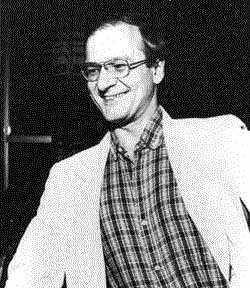
As a composer, I am frequently being asked who are my main influences and who is my contemporary music hero. As for living "classical" composers, I will have to think for a while before answering; however, if the question is revised and includes composers who should have been alive today, then my answer would be simple- Claude Vivier.

Claude Vivier (1948-1983) was a French-Canadian composer whose strange life story could easily become a New-York Times best seller, or a movie by Werner Herzog.

He was an adopted orphan to unknown parents and grew up in Montreal to a poor family. In his teens he was sent to a religious boarding school which was supposed to prepare him for a vocation in priesthood. Much more interested in poetry, guys, and in music, he enrolled at the age of 18 at the local Conservatoire in Montreal, where he studied composition with Gilles Tremblay. He completed his studies in Europe, as many composers did, with Karl-Heinz Stockhausen in Colonge.
However, he didn't reach to his mature distinctive style before he went on a trip to the far east.
This trip, most notably to Bali, has completely changed his conception about life and music.
He became immediately interested in the sounds of the east and in Eastern philosophy, and almost all the works written afterwards reveal that interest- Bouchara, Zipangu, Shiraz, Marco Polo and others.

In 1983, not yet 35, Vivier went to Paris to research the strange death of Tchaikovsky for an opera he wanted to compose. In his last diary entry he wrote that he knows that one day he is going to be stabbed to death. Later that week, he was indeed stabbed to death in a park, by a young Parisian man who was probably his lover, for reasons which remained unknown.

The music of Vivier is enchanting. The listener is easily drawn to the strange long melodies and the scents and spices of this newly undiscovered land of dreams and beauty.
I recommend listening first to his beautiful tone-poem "Lonely Child" (1980), for soprano and orchestra and to Zipangu (1980), for string orchestra. Both are available on a Philips CD, conducted by Reinbert de Leeuw.
Also highly recommended is a 2 DVD set by Opus Arte, entitled "Rêves d'un Marco Polo", which include a documentry on Vivier, and a staged concert performances of his Opera, Kopernikus, and of his most important works- Lonely Child, Prologue pour un Marco Polo, Zipangu and others.

Yet, although he is considered the finest Canadian composer of all times (Ligeti referred to him as the finest French composer of his generation), the music of Claude Vivier is widely unknown and seldomly performed or recorded. While most of his contemporaries in Europe continued their remote mathematical researches in music, and his contemporaries in America became fond of minimalism and of Neo-Romanticism, Claude Vivier found his unique voice, that didn't sound like anything else. He favoured long monophonic melodies/monodies over complex polyphonies, he mastered the essence of spectral music, without becoming too obsessed by it (as Murail and Grisey did)- and along with his studies, he remained almost an innocent child, searching for true beauty.

In an age where true beauty is a foul word and so rare to find (and usually associated with Neo romanticism and fully tonal music), Vivier's music is nothing less than a wonderful, astonishing discovery.

Friday, 9 January 2009

Ground Zero


Today you find yourself in an aggressive mood. A car's siren woke you up from a bad dream featuring your mother being gang-banged by a group of fourteen dwarfs. Your girlfriend just told you she's a lesbian, your dog is basically a cat, you find that you are adopted, and that NOISE of that car's siren drives you mad. Wait a moment, it is not only a car, it's a whole army marching down your very own street. You are asking yourself what the hell are they doing here, but you cannot finish your thought, as your upstairs neighbor has just activated his newly purchased vacuum cleaner. The noise from upstairs would be very dominant, unless the slightly retarded son of Mr. and Mrs. Rabinovich would not be practicing the drums all afternoon, and from the next-door apartment the old and deaf Mrs. Kavanova would not scream at her dead husband all day.

Such things, and more, occur at the same time in Ground Zero music, a Japanese "Hard Rock-Noise-Electronic" group.
As it is constantly multi-layered and so many things happen simultaneously, your ear is being assaulted by this hardcore blend of sounds- including car noises, sirens, all kinds of drums, turntables (played by Otomo Yushihide, also very famous in the scene on his own), occasional screams in Japanese, original samples, lots of feedback, great saxophone playing and lots of other unrecognizable noises. Basically, All-in-one. Or, in other words, everything needed for your neighbor to finally file a law suit against you and convince the others to get you out of the building, pronto.

The group worked during the 90's and has released 6 official CD's- Ground Zero, Null and Void, Revolutionary Pekinese Opera, Plays standards, Consume Red and Conflagration (most are available on iTunes). Their most ambitious and perhaps best well-known project was Consume Red, a 57 minute continuous piece, which begins with a repetitive sample of a Korean reed instrument. The music develops very slowly, almost meditatively. Only after 30 minutes sax and drums join the samples, and in the last 15 minutes you get an almost shockingly dense cloud of noise.

I, for one, prefer their slightly more accessible work, "plays standards". As the name suggests, each one of the 12 tracks is freely based on a different song (most are not that famous, except of "Those were the days" and "I say a little prayer"). Although each one of the tracks is very original and unique in its sound and mood (one track stands out- "The Bath of Surprise", which has been recorded in a bathtub), apart from two (relatively) quite songs, it is very noisy and it's generally hard to listen to the whole album from start to end.
This music is not recommended for everyone. However, it is highly recommended for anyone who can handle it, for its great originality and impressive sound structure. It is hard and sometimes unbearable- But isn't life the same?